

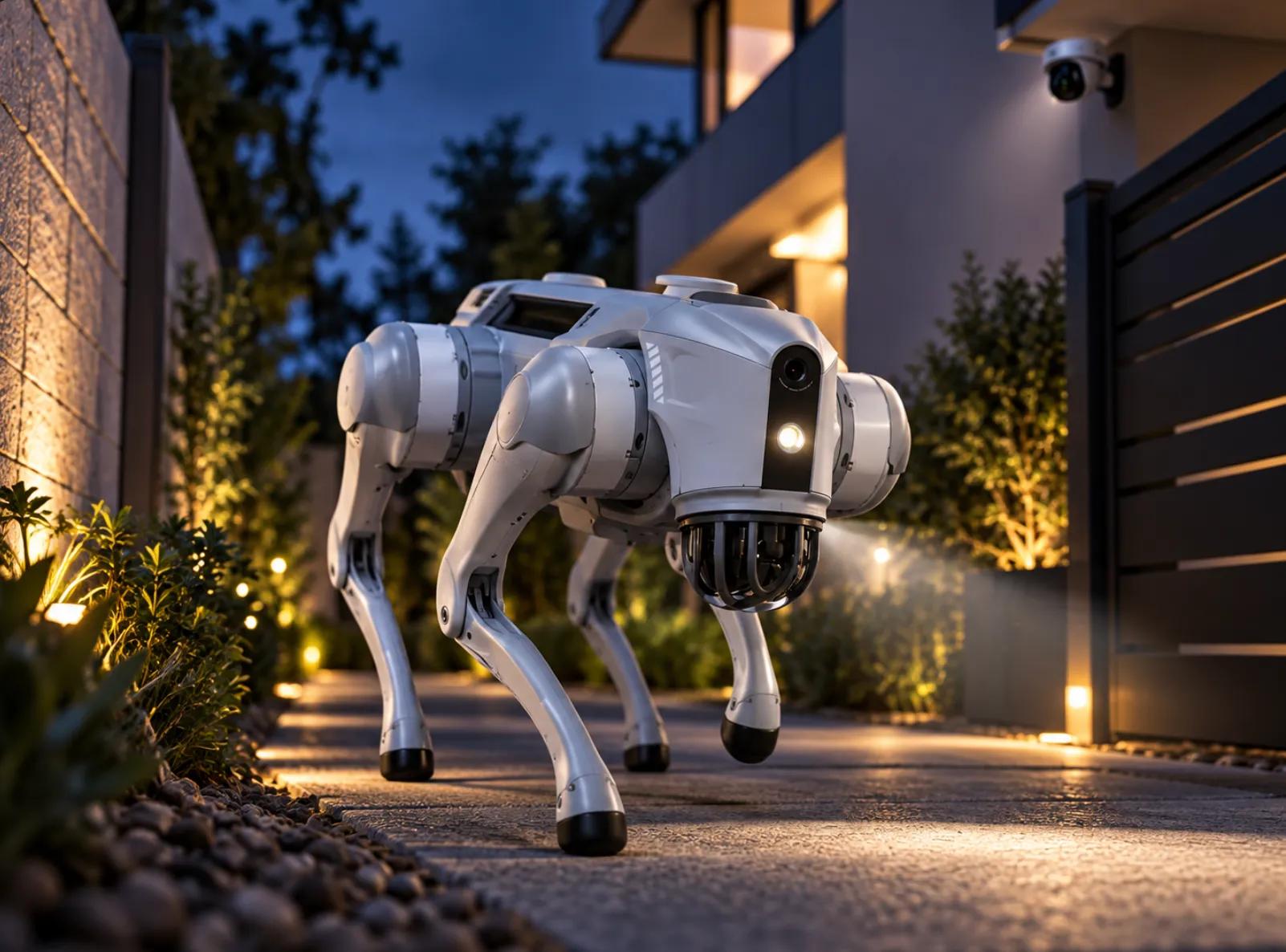
A robot dog for home security can move toward uncertainty instead of waiting for activity to enter a fixed camera’s field of view. Its strongest role is mobile verification: repositioning sensors after an alert, checking blind spots, and giving a human operator more context before deciding how to respond.

Why Do Security Alerts Still Leave Homeowners Guessing?
Most home security systems are good at detecting that something changed. A motion sensor triggers near the garage. A door opens unexpectedly. A camera captures someone entering one side of the property. The harder question comes immediately afterward: what happened next?
That gap is where a robot dog for home security becomes more interesting than another stationary camera. Instead of watching one predefined angle, a mobile quadruped can carry its viewpoint toward the area that needs clarification. An operator could reposition the robot down a hallway, toward a side entrance, or into another accessible room to gather additional visual context.
The value is not simply that the robot moves. The operational advantage is that the sensing position can change after the event begins.
A fixed camera gives persistent coverage of one scene. A mobile robot can help answer a different question: where should the camera be now?
What Can a Moving Camera See That a Fixed One Cannot?
Residential surveillance always involves tradeoffs between coverage and camera placement. A camera mounted above a garage may clearly record a driveway while seeing little around a corner. A doorbell camera can capture the front approach but cannot inspect an interior hallway. Even a multi-camera system can leave temporary blind spots when doors close, furniture blocks a view, or activity moves beyond the installed coverage.
A quadruped can change that geometry.
If its route is accessible, the robot can approach an area from another angle, move closer to an object, or continue observation after activity leaves the original camera frame. That makes mobile sensing particularly relevant for verification rather than continuous surveillance.
Consider a motion alert beside a parked vehicle. A fixed camera might show someone entering the frame and then disappearing behind the car. A mobile robot could potentially reposition to restore visibility. Inside the house, an alert near a doorway might warrant a closer view of the adjoining space before a homeowner decides whether the event is harmless or requires attention.
That does not mean the robot understands the incident. It means the operator can obtain another viewpoint without physically entering the area.
Why Is Verification More Important Than Autonomous Patrol?
It is easy to frame security robots around autonomous patrol, but residential value may emerge sooner from supervised verification.
Autonomous security requires more than locomotion. The system must determine where to go, recognize relevant events, distinguish routine activity from potentially significant behavior, operate safely around people and property, and respond appropriately when conditions fall outside its expected operating environment.
A camera, LiDAR sensor, or obstacle-detection system does not establish those capabilities by itself.
Supervised operation sets a more realistic boundary. The robot provides mobility and sensing while a person retains authority over interpretation and response. The homeowner decides whether an unknown figure is a delivery driver, family member, neighbor, or something that warrants escalation.
That division of responsibility also reduces the risk of treating AI classification as certainty. Security decisions often depend on context that a sensor cannot reliably infer from a single observation.
The robot becomes a tool for gathering better evidence, not an automatic judge of what that evidence means.
What Happens When the Robot Cannot Reach the Blind Spot?
Mobile sensing only helps when the robot can safely reach the area that needs observation.
Homes change constantly. A chair moves into a hallway. A door closes. A package appears near the entrance. A child leaves a backpack on the floor. Pets cross the route. Stairs create boundaries that may require explicit exclusion.
These conditions make route validation essential.
Operators should identify where the robot is allowed to travel, which transitions it can handle, and where human recovery may be required. A successful demonstration across an empty room does not establish reliable movement through every version of a lived-in home.
Connectivity creates another dependency. Remote video and command access depend on network coverage. Weak Wi-Fi at the edge of a property, temporary router failure, or communication loss can remove the very visibility the robot was supposed to provide.
The system therefore needs predictable behavior when control is interrupted. Buyers should verify how the selected configuration handles loss of communication and how the operator re-establishes control afterward.
Battery state matters for the same reason. A robot that provides useful verification only when charged and available needs an operating routine that keeps it ready when needed.
How Should a Robot Fit Into an Existing Security System?
The strongest architecture is layered.
Fixed cameras remain useful because they provide persistent observation without needing to move. Door sensors and motion detectors provide fast event triggers. Alarm systems manage defined security conditions. A mobile robot can add a flexible sensing layer when those systems raise a question they cannot answer from their installed position.
That creates a practical workflow:
A fixed sensor detects activity. The homeowner reviews the available camera feed. If the event remains unclear, the robot is repositioned to gather another view. A person then decides whether further action is necessary.
The robot does not need to replace the rest of the security system to create value. It needs to improve the information available between detection and response.
That distinction also gives buyers a more useful metric than patrol distance. The relevant question is whether the robot reduces the time required to obtain decision-quality visual information after an alert.
What Should Buyers Test Before Bringing One Home?
Start with the blind spots, not the robot specification sheet.
Identify the locations where the existing security system routinely leaves unanswered questions. Then determine whether a mobile platform can physically reach those areas and provide a useful camera angle.
Test the full workflow under realistic conditions. Can the operator connect quickly? Does the video remain usable while the robot moves? Are common routes reliable with normal furniture and household activity present? What happens when a door is closed or the network weakens? How will the robot be recovered if it becomes blocked?
Privacy should be included in the same evaluation. Owners should define who has control access, who can view the video feed, whether sessions are recorded, how credentials are secured, and which rooms should remain outside the robot’s permitted operating area.
For households evaluating mobile robotic monitoring, Toborlife AI’s Home Dog platform provides a quadruped option worth assessing against these requirements. Compare its supported camera functions, control methods, charging model, and mobility with the actual blind spots in your property.
Explore the Toborlife Home Dog at Toborlife AI and evaluate whether mobile verification adds meaningful information between the moment your security system detects something and the moment you decide what to do next.