

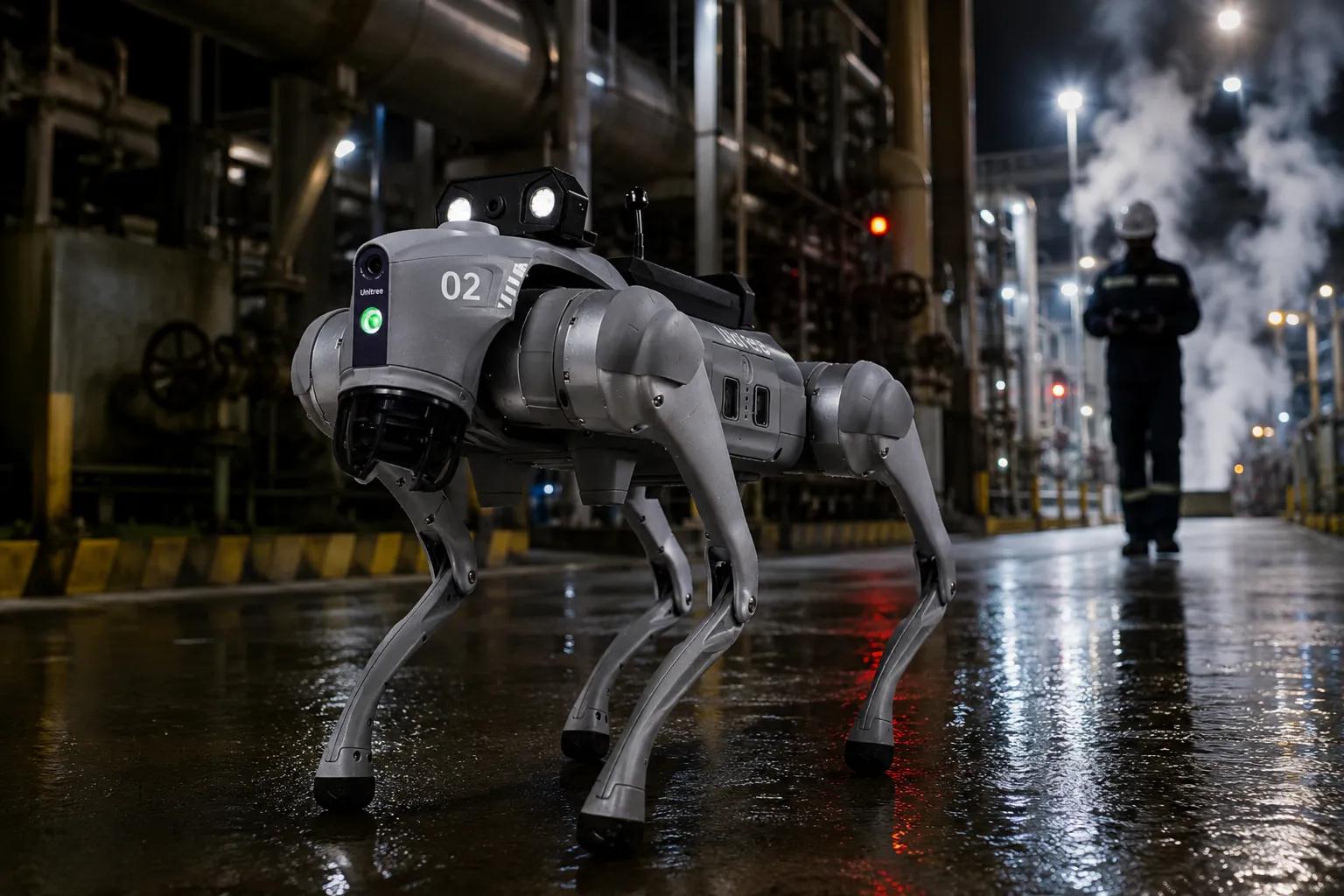
parking lot security robot
Parking lots combine large physical footprints, blind zones, repetitive patrols, and unpredictable human activity. Mobile robots can extend observation into these spaces, but the strongest deployments focus on repeatable coverage, evidence quality, operator escalation, and measurable reductions in patrol friction rather than promises of fully autonomous security.
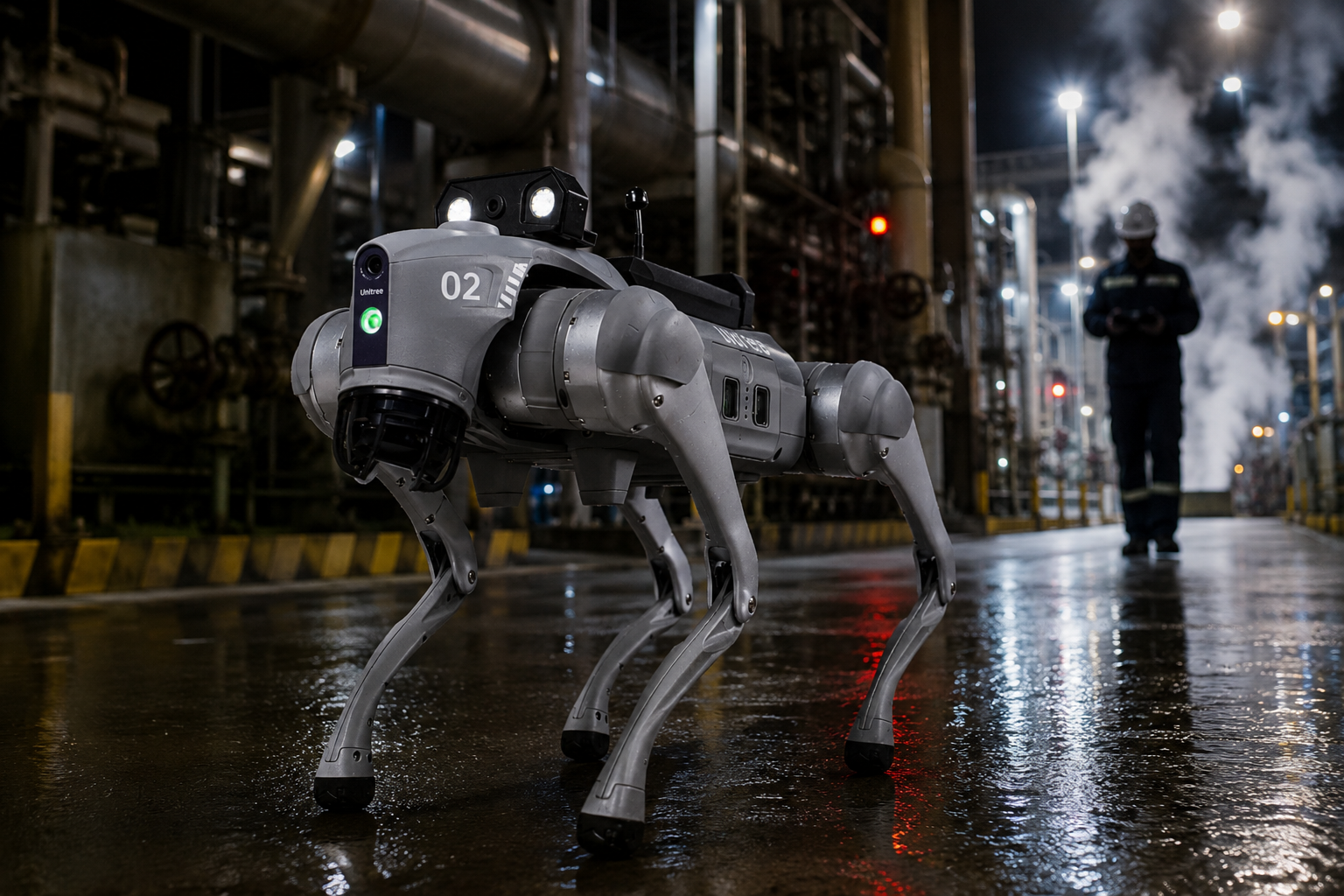
Why Are Parking Lots Harder to Secure Than They Look?
A parking lot security robot is most useful when the property has a coverage problem rather than simply a staffing problem. Parking structures, retail lots, logistics yards, hospitals, campuses, and corporate facilities often contain blind corners, long perimeter routes, changing vehicle density, uneven nighttime visibility, and areas that fixed cameras cannot continuously observe from the right angle.
Traditional security architecture usually combines cameras, lighting, access control, and human patrols. Each layer solves part of the problem.
Fixed cameras provide persistent observation within known fields of view. Guards provide judgment and flexibility but spend substantial time walking or driving routes where nothing unusual occurs.
A mobile robotic platform adds a third layer: repeatable physical observation.
The robot moves sensors through the environment while trained security personnel retain authority over interpretation, escalation, and response.
That division of labor matters.
The strongest commercial model does not automate judgment. It automates part of the coverage burden.
Where Does Human Patrol Time Actually Go?
Security teams rarely spend an entire shift responding to incidents.
Much of the work is observational.
A guard may drive through the same parking aisles, inspect entrances, check loading zones, pass stairwells, verify remote corners, and document conditions repeatedly throughout the night.
Those rounds create visibility, but they consume labor whether or not the route produces useful findings.
The hidden cost is not simply hourly staffing.
It includes the time required to traverse large properties, document routine conditions, revisit remote sections, and maintain patrol frequency during breaks, shift changes, weather events, or simultaneous incidents elsewhere on site.
When staffing becomes constrained, coverage often becomes uneven.
High traffic areas remain visible while distant corners receive less frequent attention.
A robotic patrol can make route frequency more consistent without requiring one employee to physically traverse every segment.
What Should a Security Robot Actually Observe?
The useful question is not whether the robot can move through the parking lot.
It is what operational information that movement produces.
A mobile security platform can support visible light imaging, spatial mapping, positioning, communications hardware, and application specific sensing appropriate to the facility.
That creates practical workflows.
A robot can revisit the same perimeter locations, document parked vehicle areas, inspect restricted access zones, move through garage levels, observe loading areas, and provide live remote visibility when an operator needs a closer look at a specific location.
Consistency matters because repeated sensor geometry makes comparison easier.
If the same route is observed from similar positions each night, security teams gain a structured record of environmental change rather than a collection of unrelated camera views.
The robot becomes a mobile observation layer.
Which Unitree Configuration Fits This Use Case?
The shortlist should stay narrow.
For parking structures and commercial lots, the Go2 Enterprise MPTZ is the most directly relevant Toborlife configuration because its compact quadruped form can move through parking aisles and mixed pedestrian spaces while its pan tilt zoom camera oriented configuration supports remote visual inspection without forcing an operator to reposition the entire platform for every viewpoint.
No broader catalog is necessary.
A heavy industrial quadruped may be appropriate for harsher infrastructure environments, but a parking deployment primarily needs maneuverability, repeatable observation, operator visibility, and a supportable patrol workflow.
The right robot depends on the environment, not only the spec sheet.
Can Robots Detect Suspicious Activity Automatically?
Only within clearly defined limits.
Modern perception systems can support object detection, movement awareness, mapping, and other automated observations, but a security deployment should avoid treating every detected anomaly as an incident.
A person standing near a vehicle may be waiting for a ride.
An open trunk may be normal.
A vehicle remaining in one area for an extended period may or may not justify intervention.
Physical AI does not eliminate context.
That is why the stronger operating model keeps humans in the escalation loop.
The robot provides location, imagery, sensor data, and repeatable coverage. A trained security professional determines whether the condition requires observation, communication, dispatch, or no action.
This architecture reduces false confidence while preserving the value of automation.
Why Does Nighttime Coverage Create a Stronger Use Case?
Parking facilities change substantially after normal operating hours.
Pedestrian traffic falls.
Lighting becomes more uneven.
Remote areas become harder to observe casually.
Security teams may also have fewer people covering the property.
That creates a stronger case for scheduled robotic rounds.
A quadruped can repeatedly cover validated routes while operators monitor multiple areas from a centralized position.
The commercial benefit is not autonomous crime prevention.
It is increasing the amount of property that can be observed consistently without requiring one employee to physically occupy every route.
That distinction keeps the deployment measurable.
What Happens When Something Blocks the Route?
This is where real deployment engineering begins.
Parking environments are dynamic.
Vehicles park differently every day. Shopping carts move. Construction equipment appears. Delivery trucks block lanes. Gates close. Pedestrians cross unexpectedly. Weather can alter traction and visibility.
A production system needs defined responses to those conditions.
If the robot encounters an unexpected obstruction, it should not continue simply because a navigation policy predicted a route.
The operating architecture needs explicit behavior for stopping, rerouting, requesting operator intervention, or abandoning the route safely.
The same applies to communications loss.
Security teams should know what happens if video drops, the network becomes unstable, remote commands become stale, or localization confidence degrades.
A robot that performs flawlessly only when everything behaves normally is still a demonstration.
A deployable system is defined by how it handles operational edge cases.
How Does Robotics Change Security Coverage Economics?
The ROI calculation should begin with the existing patrol architecture.
Security leaders should understand how many staff hours are currently spent on repetitive rounds, how frequently each zone is checked, how long it takes an employee to reach remote areas, and how often coverage drops because personnel are responding elsewhere.
Then the robotic system can be evaluated against measurable operating outcomes.
Does patrol frequency increase?
Does the site gain more consistent visual coverage?
Can an operator inspect a remote area without immediately dispatching someone?
Does the system produce usable incident documentation?
Does it reduce repetitive vehicle or foot patrol time without weakening response quality?
Those questions create a defensible Total Cost of Ownership model.
The relevant metric is not the cost of a robot versus the hourly wage of one guard.
It is the cost of maintaining useful security visibility across the property.
Why Do Fixed Cameras Still Matter?
Because mobile robotics should complement existing security infrastructure rather than replace it.
Fixed cameras provide persistent coverage of entrances, payment areas, elevators, gates, and other high value locations.
A mobile robot provides a changing perspective.
Those capabilities become more useful together.
A fixed camera may identify activity in a distant section of the property. A robot can then reposition for a closer view while the operator remains at the command center.
Likewise, robotic patrol records can expose persistent blind spots that justify permanent camera changes.
The strongest architecture is layered.
Access control manages entry.
Fixed cameras maintain persistent observation.
Robotics extends coverage.
Humans retain decision authority.
What Data Should the Security Team Keep?
More data is not automatically better.
A parking security system may generate video, images, maps, location records, patrol histories, alerts, and operator actions. Organizations should decide which information they actually need, how long it should be retained, and who should have access.
That becomes especially important when robots operate in spaces used by employees, visitors, residents, or customers.
Cybersecurity belongs in the same discussion.
Remote access credentials, wireless networks, software permissions, and video systems all become part of the security architecture.
A physically capable robot connected through a poorly governed network can create new operational risk while solving another.
Deployment therefore requires both physical and digital controls.
What Has to Be Engineered Before the First Patrol?
The robot itself is only one component.
A credible parking deployment requires a mapped route, validated surfaces, known slopes and transitions, wireless coverage, charging strategy, operator authority, defined observation goals, escalation procedures, data policies, maintenance ownership, and recovery behavior.
The site should also establish where robotic patrol ends.
A platform may be appropriate for garages, paved lots, service corridors, and selected perimeter routes while remaining unsuitable for certain stairways, traffic patterns, construction areas, or weather conditions.
That operating domain should be documented before routine use.
The boring questions are usually the ones that protect the budget.
Where Does Toborlife AI Create Leverage?
Toborlife AI provides the U.S. distribution and implementation layer for Unitree powered mobile robotics, treating hardware configuration, sensing, communications, logistics, site constraints, and security workflow as one deployment problem.
That changes the procurement conversation.
A parking operator should not begin with a feature comparison. The deployment should begin with the property map, patrol schedule, visibility gaps, network environment, escalation model, and current security workload.
Toborlife AI has already absorbed much of the configuration diligence, hardware integration work, domestic logistics, and deployment friction required to turn tier one robotics hardware into an operating system that a security organization can support.
For commercial teams evaluating parking garages, corporate campuses, distribution centers, hospitals, residential developments, or retail properties, the next useful artifact is a one page patrol brief containing the site map, validated route, blind zones, network assumptions, observation objectives, escalation rules, and target patrol cadence.
That brief gives Toborlife enough information to resolve the hardware, sensing, deployment, and support architecture before procurement hardens into integration debt.