

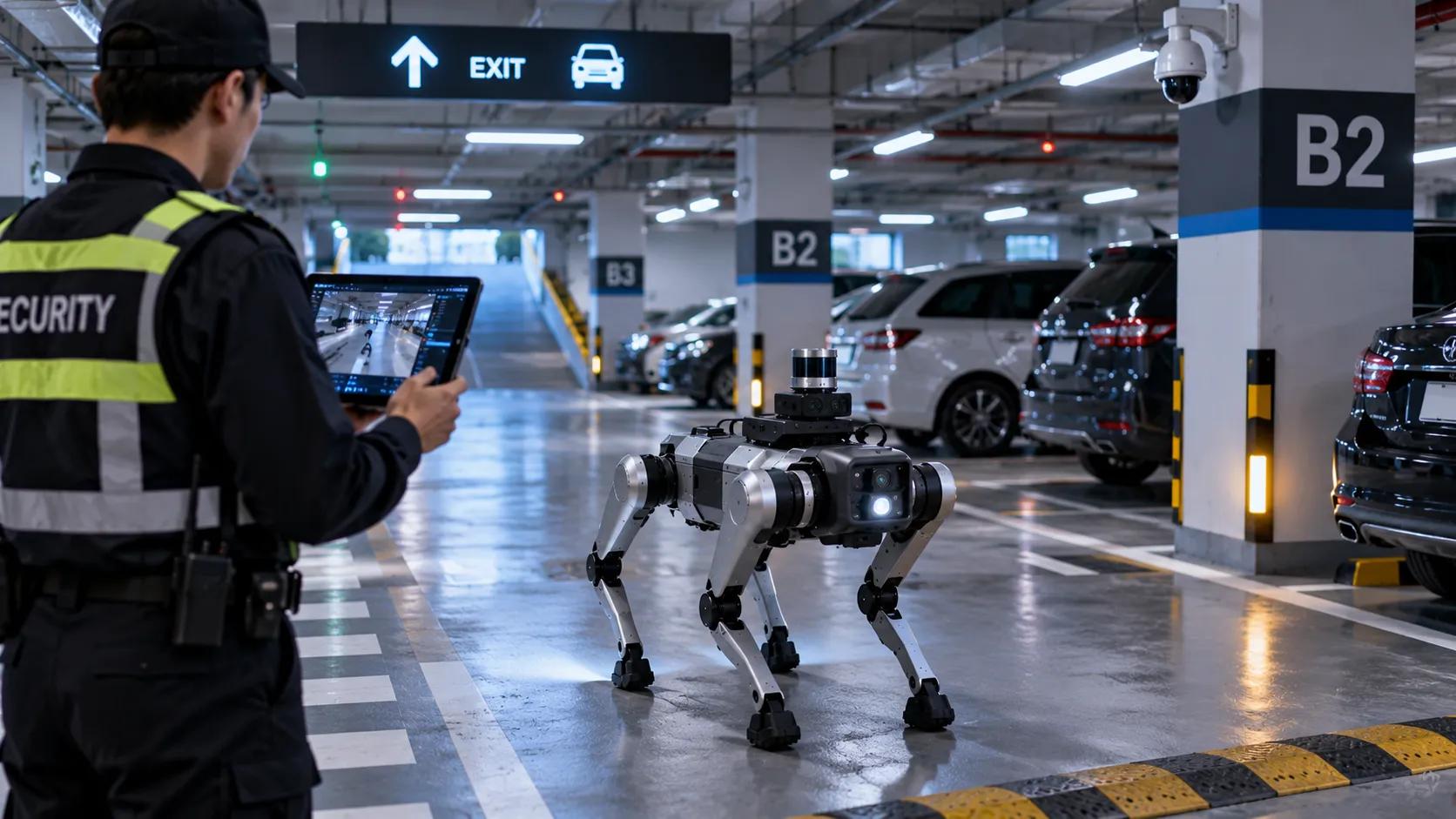
The blind spots that make mobile inspection interesting
Parking structures look straightforward from a control room. In practice, parked vehicles obscure sightlines, levels are connected by ramps, and lighting changes sharply between entrances and covered sections. A stationary camera can provide reliable coverage of a fixed viewpoint, but it cannot physically travel to inspect the other side of a parked vehicle or approach a location selected by a human operator. That difference explains the interest in a parking lot security robot. The objective is not to replace cameras, guards, or an established incident response plan. It is to add another mobile viewpoint for selected inspection tasks.

For a property manager, that distinction matters. A robot is only worthwhile if it helps someone answer a concrete question, such as whether an access gate is obstructed, whether an area needs a closer visual review, or whether an operator can inspect a predefined route without sending a person to every location.
Start with the patrol question, not the product brochure
A facility should list the decisions a mobile platform could support before evaluating hardware. Which areas have persistent visual gaps? What information must a remote operator obtain? When would a person still need to attend the scene? What happens when a route is blocked? These answers determine where mobility matters and where existing cameras are already sufficient.
The simplest initial use case may be a supervised route check during a low-traffic period. An operator follows an approved route, records observations, and compares what the mobile camera reveals against fixed viewpoints. That is a measurable trial. An open-ended claim that a robot can guard a parking lot is not. Security responsibility remains with appropriately trained staff and established procedures.
Choose the mobility format around real surfaces
Parking facilities combine smooth pavement, expansion joints, ramps, drainage channels, speed bumps, curbs, and occasionally wet or debris-covered surfaces. A quadruped may negotiate some obstacles differently from a purely wheeled platform, while a wheel-leg design may improve travel efficiency on long, smooth stretches. Neither architecture should be selected from a showcase video alone.
Unitree’s Go2 and industrial A2 families illustrate why configuration matters. A compact platform may be useful for a bounded technical trial, whereas larger industrial robots are intended for more demanding mobility and integration requirements. Inspection-focused configurations and optional payloads must be assessed on the exact model being proposed. Do not assume every robot in a family includes the same camera, LiDAR, network hardware, thermal sensor, or development interface.
The operating plan determines what the robot can contribute
Connectivity is a first-order issue. Reinforced concrete, underground levels, network handoffs, and remote corners can disrupt a control link or video feed. A pilot should map communications coverage along every proposed route and define what the operator does when the signal weakens. Equally important are battery planning, safe recovery, storage, and maintenance responsibility.
Facilities teams should create a controlled operating zone, set speed and movement limits appropriate to the site, and define a stop procedure. Vehicle traffic and pedestrians introduce unpredictable motion; a robot should not be presumed to navigate those interactions without verified capabilities and suitable supervision. The trial should include a plan for people approaching the robot, an unexpected parked obstacle, and an interrupted session.
Privacy and incident response cannot be afterthoughts
Mobile cameras can capture license plates, people, and activity at changing viewpoints. Operators should establish what is recorded, who can review footage, how long it is retained, and what site policies or legal requirements apply. A platform with cameras does not by itself provide compliant security operations, incident triage, or emergency response.
A useful workflow identifies the handoff to humans. If the operator notices something unusual, who makes the next decision? What is the escalation threshold? How are observations recorded without implying that an anomaly is proof of wrongdoing? A clear chain of responsibility helps prevent a technology demonstration from drifting into unsupported security promises.
Measure inspection value before scaling
A practical test should compare mobile checks with the site's existing method. Track route completion, operator interventions, usable camera coverage, communications interruptions, setup time, and how often a robot viewpoint actually clarifies an observation. Repeat the same path under different realistic conditions when permitted. Distinguish a successful robot movement from a useful security outcome.
The results may show that some routes benefit from mobile observation, others are better served by an added stationary camera, and a few still require a human patrol. That is a productive conclusion, not a failure. It gives the property team a defensible basis for deciding whether to continue.
Where to explore next
The opportunity in mobile security robotics is more specific than a futuristic promise of autonomous patrol. It lies in putting a useful camera viewpoint where an operator needs it, with a route and response plan that can be repeated.
If your team is assessing a parking facility, campus, or industrial site, start by mapping the visual gaps and choosing one supervised inspection task. Explore Toborlife’s quadruped lineup and talk with the team about configuration fit. A clearer operating brief is the best first step toward deciding whether a robot belongs in the workflow.